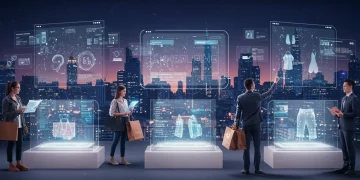
Augmented Reality in Daily Life: 3 Practical Applications for 2026
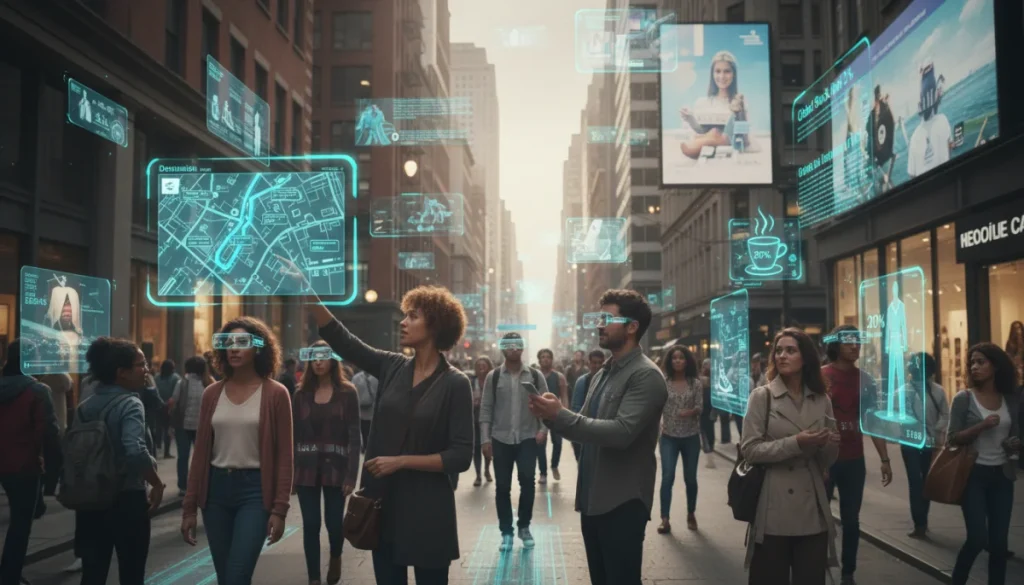
Augmented reality is set to revolutionize everyday experiences by 2026 through practical applications in smart navigation, immersive retail, and interactive education.
Imagine a world where digital information seamlessly blends with your physical environment, enhancing every aspect of your day. This isn’t science fiction; it’s the imminent reality of augmented reality applications. By 2026 and beyond, AR will move beyond novelty, becoming an indispensable tool in how we navigate, shop, and learn, fundamentally reshaping our digital lives.
The Dawn of Ubiquitous AR: Beyond the Smartphone Screen
Augmented reality (AR) has long been a fascinating concept, often associated with futuristic movies or niche gaming experiences. However, we are now on the cusp of a significant shift. The technology is maturing rapidly, moving from experimental phases to practical, everyday implementations that promise to transform how we interact with the world around us.
This evolution isn’t just about more powerful devices; it’s about sophisticated software, advanced spatial computing, and intuitive user interfaces that make AR accessible and truly useful for everyone. The promise of AR isn’t to replace reality but to augment it, layering digital information onto our physical world to provide context, convenience, and immersive experiences.
Key Technological Advancements Driving AR Adoption
Several technological breakthroughs are fueling the widespread adoption of AR. Miniaturized hardware, more efficient power consumption, and increasingly powerful mobile processors are making AR devices sleeker and more comfortable. Furthermore, significant strides in AI and machine learning are enabling AR systems to understand and interpret environments with unprecedented accuracy.
- Improved Hardware: Lighter, more fashionable AR glasses with wider fields of view.
- Advanced AI & Machine Learning: Better object recognition, spatial mapping, and context awareness.
- 5G Connectivity: Low-latency, high-bandwidth networks crucial for real-time AR data processing.
- Developer Ecosystems: Robust platforms and tools making AR content creation more accessible.
The convergence of these technologies means that by 2026, AR will no longer be confined to specialist applications. It will be integrated into the fabric of our daily routines, offering practical benefits that enhance productivity, entertainment, and connection. This next wave of AR is about utility, making our lives easier and more informed, rather than just providing a fleeting digital spectacle.
Application 1: Smart Navigation and Urban Exploration
One of the most immediate and impactful applications of augmented reality is in navigation. Forget constantly looking down at your phone; imagine walking through a city with digital arrows, points of interest, and real-time information overlaid directly onto your view of the street. This isn’t just about getting from point A to point B; it’s about enriching the entire journey.
By 2026, AR-powered navigation will be a standard feature in many smart glasses and even advanced smartphone apps. It will offer turn-by-turn directions that adapt to your exact perspective, highlighting landmarks and showing you exactly where to go. This capability extends beyond driving or walking, proving invaluable in complex environments like airports, train stations, or large shopping malls.
Enhancing Public Transit and Tourism
For public transit users, AR can display real-time bus or train schedules, indicate which platform to use, and even show the occupancy levels of incoming vehicles. Tourists will benefit immensely, with AR providing instant translations of signs, historical information about buildings as they look at them, and recommendations for nearby attractions, all without breaking their immersion in the environment.
The potential for smart navigation to reduce stress and improve efficiency in urban environments is enormous. No more fumbling with maps or asking for directions; your AR device becomes an intuitive guide, making every trip smoother and more enjoyable. This technology democratizes exploration, allowing anyone to navigate unfamiliar places with confidence and discover hidden gems along admittedly the journey.
Ultimately, AR in navigation is about empowering individuals with context-aware information, transforming mundane commutes into insightful journeys and making new places feel instantly familiar. This seamless integration of digital guidance into our real-world view represents a significant leap forward in personal mobility and urban interaction.
Application 2: Immersive Retail and Personalized Shopping Experiences
The retail sector is ripe for disruption by augmented reality, offering consumers unprecedented ways to interact with products before making a purchase. The traditional boundaries between online and in-store shopping are blurring, as AR provides a bridge that enhances both experiences. By 2026, AR will be a cornerstone of personalized shopping, allowing consumers to try on clothes virtually, visualize furniture in their homes, and receive contextual product information.
Imagine browsing an online store and, with a tap, seeing how a new sofa would look in your living room, scaled accurately and lit realistically. Or stepping into a virtual dressing room from your home, trying on different outfits without the hassle of physical changing rooms. These capabilities not only boost consumer confidence but also significantly reduce returns, benefiting both shoppers and retailers.
Transforming the In-Store Experience
In physical stores, AR can provide rich, interactive product information. Point your phone or AR glasses at an item, and instantly see reviews, nutritional facts, available sizes, or even a demonstration video. This empowers shoppers with knowledge, turning a passive browsing experience into an active, informed decision-making process. Retailers can also use AR to create engaging in-store scavenger hunts or personalized promotions based on a customer’s shopping history and location within the store.
- Virtual Try-On: Clothes, accessories, and makeup can be virtually applied to the user.
- Home Visualization: Furniture and decor can be placed virtually in a user’s home environment.
- Interactive Product Information: Instant access to reviews, specs, and usage guides in-store.
- Personalized Offers: Location-based AR promotions delivered directly to the shopper.
The shift towards immersive retail driven by AR is not just about novelty; it’s about efficiency, personalization, and reducing friction in the buying process. It creates a more engaging and satisfying shopping journey, whether online or in a physical store, ultimately leading to better customer satisfaction and stronger brand loyalty.
Application 3: Enhanced Learning and Interactive Education
Education stands to be profoundly transformed by augmented reality, moving beyond textbooks and static diagrams to deliver truly immersive and interactive learning experiences. By 2026, AR will be a powerful tool in classrooms and for self-learners, making complex subjects more accessible and engaging. From virtual dissection in biology to interactive historical reconstructions, AR offers a dynamic way to explore knowledge.
Imagine a history lesson where students can walk through a reconstructed ancient Roman city, interacting with virtual citizens and understanding the architecture in 3D. Or a physics class where abstract concepts like gravitational waves are visualized as tangible, interactive phenomena right in the classroom. AR makes learning experiential, bridging the gap between theoretical knowledge and practical understanding.
Making Complex Subjects Accessible
For subjects like anatomy, engineering, or chemistry, AR can project detailed 3D models that students can manipulate, zoom into, and examine from every angle. This level of interaction was previously only possible with expensive physical models or complex simulations, often out of reach for many educational institutions. AR democratizes access to these advanced learning tools.
- 3D Model Interaction: Explore complex structures like the human heart or a jet engine in full 3D.
- Virtual Field Trips: Visit historical sites or distant ecosystems without leaving the classroom.
- Interactive Simulations: Conduct virtual experiments safely and repeatedly.
- Gamified Learning: Transform lessons into engaging, interactive challenges.
The ability of AR to provide context-rich, hands-on learning experiences is unparalleled. It caters to different learning styles, making education more inclusive and effective. As AR technology becomes more affordable and widespread, it will empower educators to create more dynamic curricula and inspire a new generation of learners with captivating, interactive content.
The Ethical Considerations and Future Outlook of AR
As augmented reality becomes more integrated into our daily lives, it’s crucial to address the ethical implications and consider the broader societal impact. While the benefits are clear, questions around privacy, data security, digital distraction, and equitable access must be carefully navigated. Ensuring responsible development and deployment of AR technologies will be paramount to realizing their full potential without compromising individual rights or well-being.
Privacy concerns arise from AR devices constantly scanning and interpreting our environments, potentially capturing sensitive personal data or even identifying individuals without consent. Data security is another critical area, as AR systems will process vast amounts of personal and environmental data, making them attractive targets for cyberattacks. Developers and regulators must collaborate to establish robust frameworks that protect user privacy and secure data.
Addressing Challenges for Widespread Adoption
Beyond ethics, practical challenges remain for widespread AR adoption. Affordability of high-quality AR hardware, battery life limitations, and the need for standardized content creation tools are all areas requiring further innovation. However, the rapid pace of technological advancement suggests that many of these hurdles will be overcome in the coming years, paving the way for AR to become as ubiquitous as smartphones are today.
The future of augmented reality is not just about the technology itself, but about how we choose to integrate it into our lives. It offers incredible potential to enhance human capabilities, streamline tasks, and create richer experiences. By proactively addressing the challenges and focusing on user-centric design, we can ensure that AR serves as a tool for empowerment and connection, rather than just another source of digital noise. The journey towards a truly augmented world is exciting, filled with possibilities, and demands thoughtful consideration at every step.
Preparing for an Augmented Future: Skills and Adaptation
The rapid advancement of augmented reality isn’t just changing how we interact with technology; it’s also reshaping the skills needed in the workforce and the way we adapt to new digital environments. As AR becomes more prevalent, individuals and businesses will need to cultivate new competencies to leverage its full potential. This includes understanding AR interfaces, developing spatial computing literacy, and adapting to new forms of data visualization.
For professionals, this might mean learning how to design AR experiences, manage AR-enhanced workflows, or analyze data gathered through AR interactions. For consumers, it involves becoming comfortable with overlaying digital information onto their physical world and discerning valuable augmentations from distractions. The ability to seamlessly blend physical and digital information will become a crucial skill in navigating the future.
Educational and Professional Development in AR
Educational institutions are already beginning to integrate AR into their curricula, preparing students for a world where augmented interfaces are common. This includes courses in 3D modeling, user experience (UX) design for AR, and programming for spatial computing platforms. Companies are also investing in training programs to upskill their employees, ensuring they can utilize AR tools for tasks ranging from maintenance and repair to collaborative design.
- Spatial Computing Literacy: Understanding how to interact with digital objects in 3D space.
- AR UX/UI Design: Creating intuitive and effective augmented reality interfaces.
- Data Interpretation: Analyzing and acting upon information presented through AR overlays.
- Ethical AR Development: Designing AR experiences with privacy and user well-being in mind.
Embracing these new skills is not just about staying competitive; it’s about unlocking new opportunities and enhancing personal and professional effectiveness. The augmented future will reward those who can think creatively about how digital overlays can solve real-world problems and who are adaptable enough to learn and master new interaction paradigms. The journey of adaptation is continuous, and AR represents a significant milestone in that evolution.
| Key Application | Brief Description |
|---|---|
| Smart Navigation | Real-time directions and points of interest overlaid onto the physical world, enhancing urban exploration and transit. |
| Immersive Retail | Virtual try-ons, home visualization, and interactive product information for personalized shopping experiences. |
| Interactive Education | 3D models, virtual field trips, and simulations make complex subjects engaging and accessible for learners. |
| Ethical Considerations | Addressing privacy, data security, and digital distraction for responsible AR development and adoption. |
Frequently asked questions about augmented reality
Augmented reality (AR) overlays digital information onto the real world, enhancing what you already see. Virtual reality (VR), conversely, creates an entirely simulated environment, completely immersing the user and blocking out the physical world. AR adds to reality; VR replaces it.
While AR glasses are expected to take over many smartphone functions, a complete replacement is unlikely in the short term. They will likely coexist, with AR glasses serving as a more immersive, hands-free interface for digital interactions, while smartphones continue to offer a tactile, versatile computing platform for specific tasks.
AR’s constant scanning of environments raises significant privacy concerns, as devices could capture personal data or identify individuals. Robust regulations and transparent data handling policies will be crucial. Users will need to be mindful of what information their AR devices are collecting and how it’s being used to safeguard their privacy.
Key challenges include the high cost of advanced AR hardware, limited battery life, the need for comfortable and aesthetically pleasing designs, and the development of compelling, standardized content. Overcoming these hurdles will be essential for AR to achieve widespread consumer adoption beyond niche markets.
Absolutely. AR can significantly boost workplace productivity by providing hands-free access to information, overlaying instructions for complex tasks, facilitating remote collaboration with shared digital environments, and offering real-time data visualization. This applies across various industries, from manufacturing and healthcare to design and logistics.
Conclusion
The journey of augmented reality from concept to everyday utility is accelerating, with 2026 poised to be a pivotal year for its integration into our digital lives. The practical applications in smart navigation, immersive retail, and interactive education demonstrate AR’s immense potential to enhance our experiences, streamline tasks, and open new avenues for learning and interaction. While ethical considerations and technological challenges remain, the clear benefits and rapid advancements suggest that an augmented future is not just inevitable, but desirable. As we move forward, embracing this technology thoughtfully will allow us to unlock its full power, creating a more informed, connected, and engaging world for everyone.