Decentralized Social Media 2026: Top 3 Platforms Explored
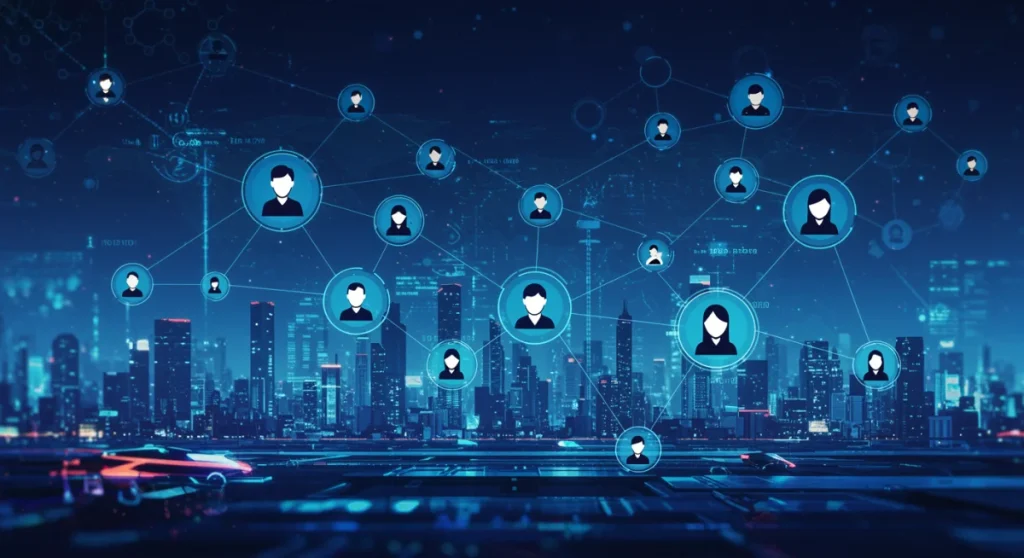
Decentralized social media platforms are poised to redefine online interaction by 2026, offering users greater control over their data and content through blockchain technology and community governance, moving away from traditional centralized models.
The digital landscape is constantly evolving, and by 2026, a significant shift is underway: decentralized social media is emerging as a powerful alternative to the traditional, centralized platforms we’ve known for years. This isn’t just a fleeting trend; it’s a fundamental re-imagining of how we connect, share, and interact online, driven by a growing demand for user control, data privacy, and censorship resistance. As we look ahead, understanding these platforms becomes crucial for anyone navigating the complexities of digital life.
Understanding the shift to decentralized social media
The transition to decentralized social media represents a profound paradigm shift from the status quo. For decades, platforms like Facebook, Twitter, and Instagram have operated under a centralized model, where a single entity controls all data, content, and user interactions. This model, while efficient in its early days, has led to significant concerns regarding privacy, data ownership, content moderation, and censorship. Users have increasingly felt like products rather than participants, with their data monetized and their voices potentially stifled.
Decentralized social media, often built on blockchain technology, proposes a different path. Instead of data residing on a single company’s servers, it’s distributed across a network of computers, making it far more resilient to single points of failure, censorship, and manipulation. This architectural choice empowers users by giving them more direct control over their digital identities and content. It’s about putting the power back into the hands of the community, fostering a more equitable and transparent online environment.
The core principles of decentralization
At its heart, decentralization is about distributing power and control. In the context of social media, this translates into several key advantages:
- User data ownership: Users retain full ownership and control over their personal data, deciding what to share and with whom.
- Censorship resistance: Without a central authority, it’s significantly harder for any single entity to censor or remove content.
- Transparency: The underlying code and governance mechanisms are often open-source and transparent, fostering trust.
- Community governance: Decisions about platform rules and development are often made by the user community, not a corporate board.
This foundational shift addresses many of the criticisms leveled against traditional social media, paving the way for a more democratic and user-centric digital future. The implications for freedom of speech and digital rights are substantial, promising a new era of online interaction.
The evolving landscape of digital interaction
The digital world of 2026 is one where users are increasingly wary of surveillance capitalism and the arbitrary power wielded by tech giants. This growing awareness is a primary catalyst for the accelerated adoption of decentralized alternatives. People are actively seeking platforms that align with their values of privacy, autonomy, and open dialogue. The conversation has moved beyond mere convenience to fundamental rights in the digital sphere.
Traditional social media platforms, while still dominant, are facing increasing scrutiny from regulators and users alike. Concerns over algorithmic bias, the spread of misinformation, and the mental health impact of highly addictive interfaces are pushing many to explore new avenues. Decentralized platforms offer a compelling counter-narrative, promising a healthier and more authentic online experience. They are not just replicating existing features; they are innovating with new models of interaction and value creation.
Key drivers for decentralized adoption
Several factors are converging to fuel the growth of decentralized social media:
- Privacy concerns: High-profile data breaches and privacy scandals have eroded trust in centralized platforms.
- Censorship debates: Content moderation controversies have highlighted the need for more neutral and community-driven platforms.
- Web3 innovation: Advancements in blockchain, NFTs, and cryptocurrencies are enabling new economic models for content creators and users.
- Desire for ownership: Users want to own their digital assets and data, rather than merely rent space on a platform.
This confluence of technological progress and shifting user expectations is creating fertile ground for decentralized social media to flourish. The promise of an internet that truly belongs to its users is a powerful draw, attracting both developers and a growing user base. The landscape is not just evolving; it’s undergoing a fundamental transformation.
Platform spotlight: Mastodon and its federated model
Mastodon stands out as a pioneering example in the decentralized social media space, operating on a federated model known as ActivityPub. Unlike a single, monolithic platform, Mastodon consists of thousands of independent servers, or ‘instances,’ each with its own rules, moderation policies, and community focus. Users choose an instance to join, but can still follow and interact with users on any other Mastodon instance. This interconnected network creates a vast, diverse, and resilient social fabric.
The beauty of Mastodon lies in its flexibility and community-driven nature. If a user dislikes the policies of one instance, they can simply move to another, taking their followers and content with them. This inherent portability and choice contrast sharply with centralized platforms, where users are locked into a single ecosystem. By 2026, Mastodon has solidified its position as a robust alternative for those seeking a more ethical and personalized social media experience, free from corporate algorithms dictating their feed.
Recent updates and growing influence
In recent years, Mastodon has seen significant improvements in user experience and accessibility. Developers have focused on making the onboarding process smoother for new users, while enhancing features like content filtering and advanced moderation tools for instance administrators. The platform’s federated nature has proven particularly attractive to communities seeking niche spaces or those disillusioned with the content policies of mainstream sites.
- Enhanced user interfaces: Third-party apps and web interfaces offer diverse customization options.
- Improved moderation tools: Instance administrators have more robust tools to manage their communities effectively.
- Increased interoperability: Connections with other ActivityPub-enabled platforms are expanding, creating a broader fediverse.
- Growing developer ecosystem: A vibrant community of developers continually contributes to Mastodon’s evolution.
Mastodon’s federated architecture provides a scalable and sustainable model for decentralized social media, proving that a large, interconnected social network can thrive without a single corporate overlord. Its continued growth signals a strong demand for alternatives that prioritize user autonomy and community well-being.
Platform spotlight: Lens Protocol and the web3 social graph
Lens Protocol emerges as a significant player in the decentralized social media arena, offering a fundamentally different approach to social networking by building directly on the blockchain. Instead of a platform owning your social graph – your connections, content, and interactions – Lens Protocol allows users to own their social profile as an NFT. This means your digital identity, your followers, and your content creations are truly yours, stored on a public blockchain, primarily Polygon.
This innovative model transforms every post, comment, and follow into a verifiable transaction on the blockchain, granting unprecedented transparency and ownership. By 2026, Lens Protocol has attracted a growing number of developers and content creators who are building various social applications on top of its open social graph. Users can switch between different Lens-enabled apps without losing their identity or content, fostering a truly interoperable social experience. This freedom from vendor lock-in is a game-changer, giving users genuine control over their digital legacy.

Recent updates and ecosystem growth
Lens Protocol has seen rapid development and adoption since its inception. Recent updates have focused on expanding its functionality, improving scalability, and fostering a robust ecosystem of applications. The protocol now supports more complex content types and has integrated with various Web3 wallets and services, making it easier for users to manage their on-chain social presence.
- NFT-based profiles: Users own their profile as an NFT, ensuring true digital ownership.
- Interoperable content: Content created on one Lens app is accessible across all others.
- Creator monetization: New models allow creators to directly monetize their content and audience.
- Thriving dApp ecosystem: A diverse range of decentralized applications are built on Lens, from blogging platforms to video sharing.
The promise of Lens Protocol is a future where your social identity is a portable, owned asset, not something leased from a corporation. This empowers users and creators in ways previously unimaginable, laying the groundwork for a truly decentralized and user-centric social internet.
Platform spotlight: Farcaster and its open protocol
Farcaster is another compelling example in the decentralized social media landscape, distinguishing itself through its focus on an open protocol designed for building social applications. While it shares some philosophical similarities with Lens Protocol in granting users ownership of their data, Farcaster emphasizes a more direct, developer-friendly approach to creating new social experiences. It operates on a hybrid model, using Ethereum for identity and a decentralized network for messages, aiming for both security and scalability.
By 2026, Farcaster has gained traction among developers and early adopters who appreciate its minimalist design and the robust infrastructure it provides for building custom social clients. The protocol’s emphasis on short-form content, similar to early Twitter, has fostered vibrant, focused communities. Users register an identity on the Ethereum blockchain, which then allows them to interact across various applications built on the Farcaster protocol. This separation of identity from application fosters innovation and prevents any single entity from controlling the social layer.
Recent updates and community engagement
Farcaster has been undergoing continuous development, with recent updates aimed at enhancing its core protocol and expanding its utility. Efforts have focused on improving message propagation, optimizing storage, and refining the developer SDK to make it even easier to build new ‘casts’ (social apps) on the network. The community around Farcaster is highly engaged, actively contributing to the protocol’s evolution and creating a diverse range of clients.
- Ethereum-based identity: Secure, self-sovereign user identities on the blockchain.
- Developer-centric approach: An open protocol encourages diverse application development.
- Focus on short-form content: Fosters concise and impactful interactions.
- Growing ecosystem of clients: Multiple interfaces allow users to choose their preferred social experience.
Farcaster represents a powerful vision for a decentralized social internet where the underlying protocol is open and extensible, allowing for a Cambrian explosion of social applications. Its commitment to user ownership and developer freedom positions it as a key player in the future of digital interaction.
The challenges and future of decentralized social media
While the promise of decentralized social media is immense, its path to mainstream adoption is not without hurdles. One of the primary challenges lies in user experience. Many decentralized platforms, by their very nature, require a degree of technical understanding that can be daunting for the average user. Concepts like seed phrases, wallet management, and understanding governance models can create barriers to entry. The user interfaces, while improving, often lack the polish and intuitive design of their centralized counterparts.
Another significant challenge is scalability. Blockchain networks, while secure and decentralized, can sometimes struggle with the sheer volume of transactions required to support a global social media platform. Innovations in layer-2 solutions and more efficient consensus mechanisms are addressing this, but it remains an ongoing area of development. Content moderation also presents a complex issue; without a central authority, establishing effective and fair moderation policies that prevent harmful content while preserving free speech is a delicate balancing act.
Overcoming adoption barriers
To truly break into the mainstream, decentralized social media platforms must focus on several key areas:
- Improved UX/UI: Making platforms as intuitive and easy to use as centralized alternatives.
- Scalability solutions: Implementing technologies that can handle massive user bases and high transaction volumes.
- Effective moderation models: Developing community-driven or AI-assisted moderation systems that are fair and transparent.
- Education and awareness: Informing users about the benefits and mechanics of decentralization.
Despite these challenges, the trajectory for decentralized social media in 2026 is overwhelmingly positive. The ongoing innovation, coupled with a growing demand for user-centric digital environments, suggests a future where these platforms play an increasingly vital role in our online lives. The shift is not a matter of if, but when, and how quickly these platforms can overcome their current limitations to appeal to a broader audience.
| Key Aspect | Description |
|---|---|
| User Ownership | Users control their data and digital identity, often via blockchain. |
| Censorship Resistance | Absence of central authority reduces risk of content removal. |
| Community Governance | Users often participate in decisions shaping platform rules and future. |
| Interoperability | Ability to move identity and content across different decentralized apps. |
Frequently asked questions about decentralized social media
Decentralized social media refers to platforms built on distributed networks, often using blockchain technology. Unlike traditional platforms, there’s no single central entity controlling user data or content, giving users more autonomy and reducing censorship risks.
These platforms enhance privacy by distributing data across many nodes, making it harder to compromise. Users typically own their data and digital identities, deciding what information to share and with whom, rather than a corporation owning it.
Key advantages include user data ownership, resistance to censorship, transparent governance, and the ability to move your social identity and content between different applications without vendor lock-in. This fosters a more open and fair digital environment.
While historically more complex, platforms like Mastodon, Lens Protocol, and Farcaster are rapidly improving their user interfaces and onboarding processes. The goal is to make them as intuitive as centralized platforms, reducing the technical barrier to entry for mainstream users.
Blockchain technology provides the foundational layer for decentralized social media by enabling secure, immutable, and transparent record-keeping. It underpins user identities, content ownership (e.g., NFTs), and ensures that data is distributed rather than centrally controlled.
Conclusion
The landscape of social media is undoubtedly undergoing a significant transformation by 2026, with the rise of decentralized social media platforms like Mastodon, Lens Protocol, and Farcaster leading the charge. These innovations are not merely incremental improvements; they represent a fundamental shift in how we perceive and interact with digital communities. By prioritizing user ownership, data privacy, and resistance to censorship, these platforms are building a more democratic and equitable internet. While challenges remain in terms of scalability and user experience, the rapid pace of development and the growing demand for alternatives suggest a future where decentralized social media plays a pivotal role in shaping our digital lives. The era of centralized control is slowly giving way to a more open, transparent, and user-empowered online world.